
Hidden Liquidity Flow
How the Hidden Liquidity Flow oscillator tracks institutional accumulation and distribution beneath price action.
Hidden Liquidity Flow is the long-term component of Momentum Concepts. It tracks what is commonly referred to as "smart money" activity — the accumulation and distribution of positions by institutional traders and large market participants that is not immediately visible from price action alone.
What Is Liquidity Flow?
Price movements are driven by the balance of buying and selling pressure. While retail traders tend to react to price visually, institutional traders accumulate or distribute positions gradually over time, often without causing obvious price spikes. Hidden Liquidity Flow aims to detect this underlying activity.
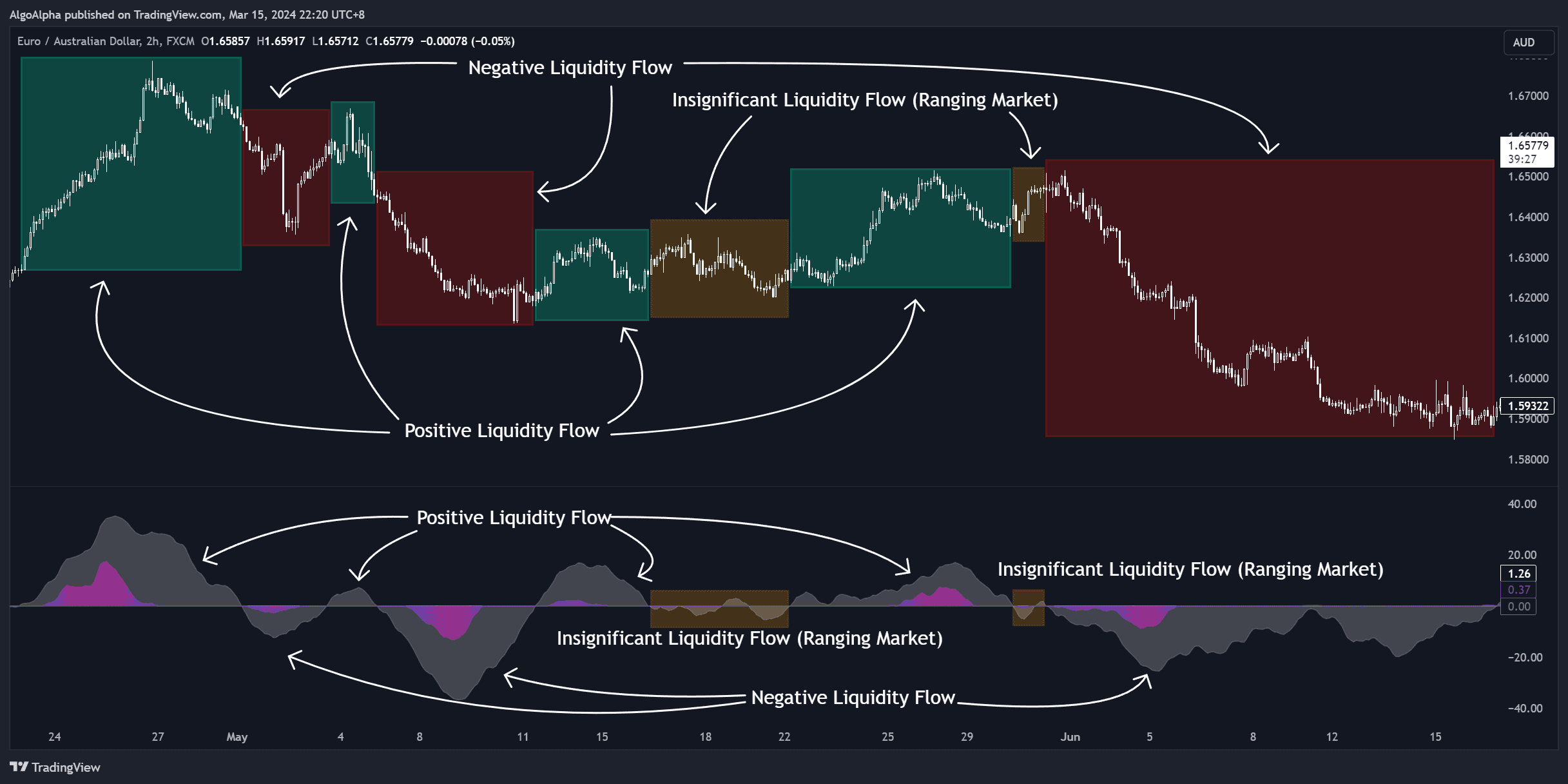
- Positive flow (above zero): Net liquidity is entering the market — institutional buyers are accumulating, which is generally bullish
- Negative flow (below zero): Net liquidity is leaving the market — institutional sellers are distributing, which is generally bearish
- Flow near zero: No clear institutional bias — the market may be in a neutral or transitional state
How It Works
Hidden Liquidity Flow analyzes the relationship between price movement, volume, and order flow characteristics to estimate whether large participants are net buyers or net sellers. It uses proprietary calculations that go beyond simple volume analysis to infer the direction and intensity of institutional activity.
The oscillator updates as each bar closes, building a cumulative picture of whether smart money is flowing into or out of the asset over time.
Reading the Oscillator
| Visual Element | Meaning |
|---|---|
| Rising positive bars | Institutional accumulation is increasing — bullish |
| Falling positive bars | Accumulation is slowing — potential momentum peak |
| Rising negative bars (toward zero) | Distribution is decreasing — selling pressure easing |
| Falling negative bars | Distribution is intensifying — bearish |
| Zero line cross (upward) | Net flow has shifted from institutional selling to buying |
| Zero line cross (downward) | Net flow has shifted from institutional buying to selling |
Divergence with Price
Some of the most powerful signals from Hidden Liquidity Flow occur when it diverges from price:
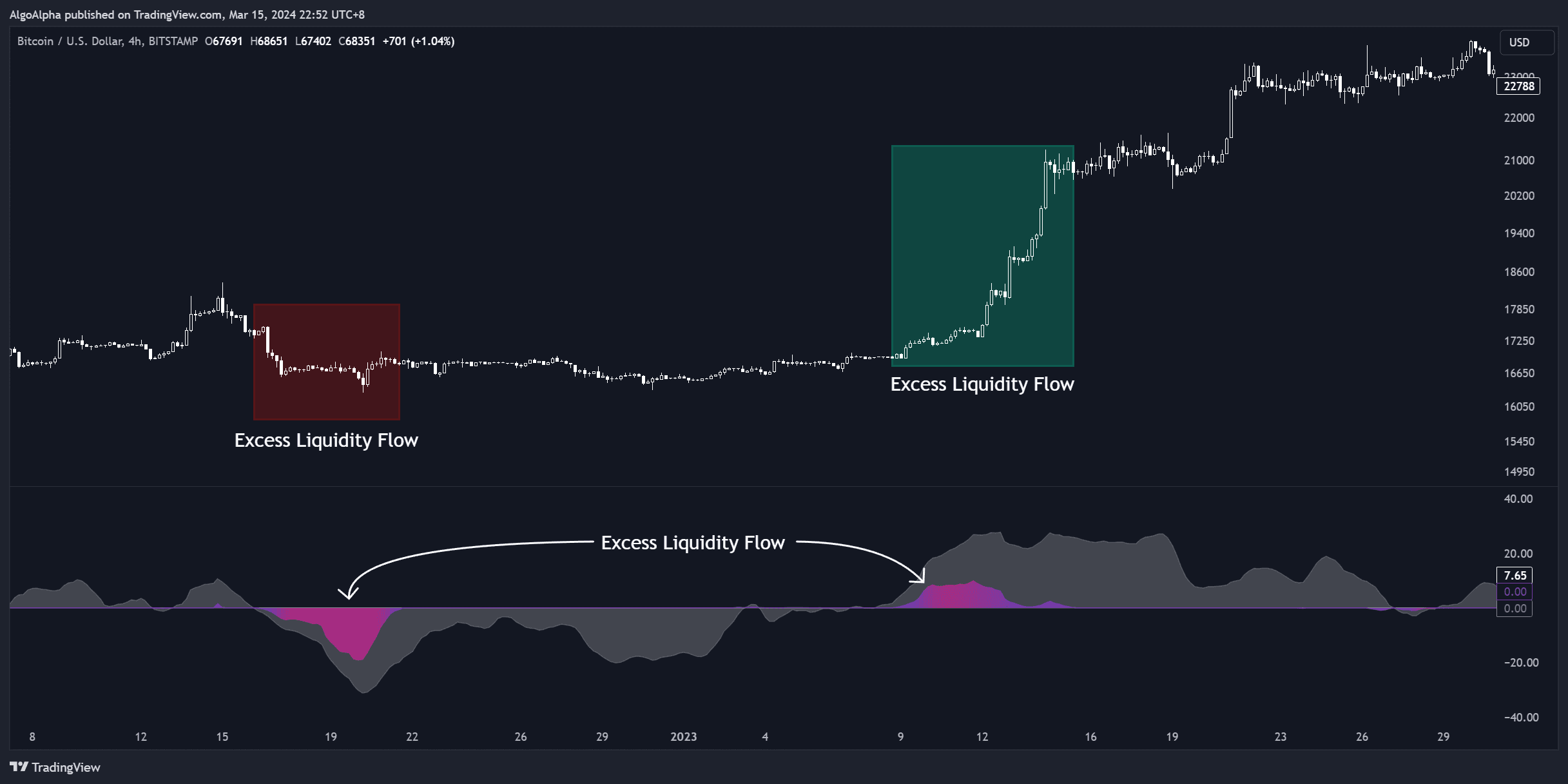
- Price making new highs while flow is declining: Suggests the rally is not backed by institutional buying — potential distribution (bearish divergence)
- Price making new lows while flow is rising: Suggests smart money is accumulating despite the selloff — potential accumulation (bullish divergence)
These divergences often precede major trend changes because they reveal that the dominant participants are positioning against the visible price trend.
Trading with Hidden Liquidity Flow
Trend Validation
Before entering any position, check Hidden Liquidity Flow for confirmation:
- If you want to go long, Hidden Liquidity Flow should be positive or rising
- If you want to go short, it should be negative or falling
- If flow contradicts your trade direction, reconsider the setup
Breakout Confirmation
When price breaks a key level (such as a BOS event on ILPAC), checking whether Hidden Liquidity Flow supports the breakout helps distinguish genuine moves from false breakouts:
- Breakout + positive flow: The breakout is supported by institutional buying — higher probability
- Breakout + negative flow: The breakout may lack institutional backing — higher risk of failure
Regime Filter
Hidden Liquidity Flow works as a macro regime filter for your overall trading bias:
- When flow is strongly positive, maintain a bullish bias across all strategies
- When flow is strongly negative, maintain a bearish bias
- When flow is flat, reduce position sizes and expect choppy conditions
Hidden Liquidity Flow is most meaningful on timeframes of 1 hour and above. On very low timeframes, the signal becomes noisy. For intraday timing, use the Fast Oscillator or Scalper's Momentum instead.
Combining with Other Components
Hidden Liquidity Flow is most powerful when used in conjunction with the other Momentum Concepts oscillators:
- Flow bullish + Momentum Impulse bullish + Fast Oscillator at oversold: All three momentum horizons align for a high-conviction long entry
- Flow diverging bearishly while Fast Oscillator signals long: The short-term signal may work for a quick trade, but the longer-term picture suggests caution — trade smaller and with tighter stops