
Momentum Impulse Oscillator
How the Momentum Impulse oscillator filters market noise to identify genuine trending and consolidation regimes.
The Momentum Impulse Oscillator is the medium-to-long-term component of Momentum Concepts. It is designed to filter out market noise and distinguish between genuine trending conditions and sideways consolidation — helping you avoid entering positions during choppy, directionless markets.
How It Works
The Momentum Impulse applies multiple layers of smoothing and noise reduction to raw momentum data. Unlike the Fast Oscillator (which responds quickly to every price swing), the Impulse deliberately ignores minor fluctuations and only registers when a sustained directional move is underway.
The result is a clean histogram that clearly shifts between positive (bullish impulse) and negative (bearish impulse) states, with minimal whipsawing during range-bound conditions.
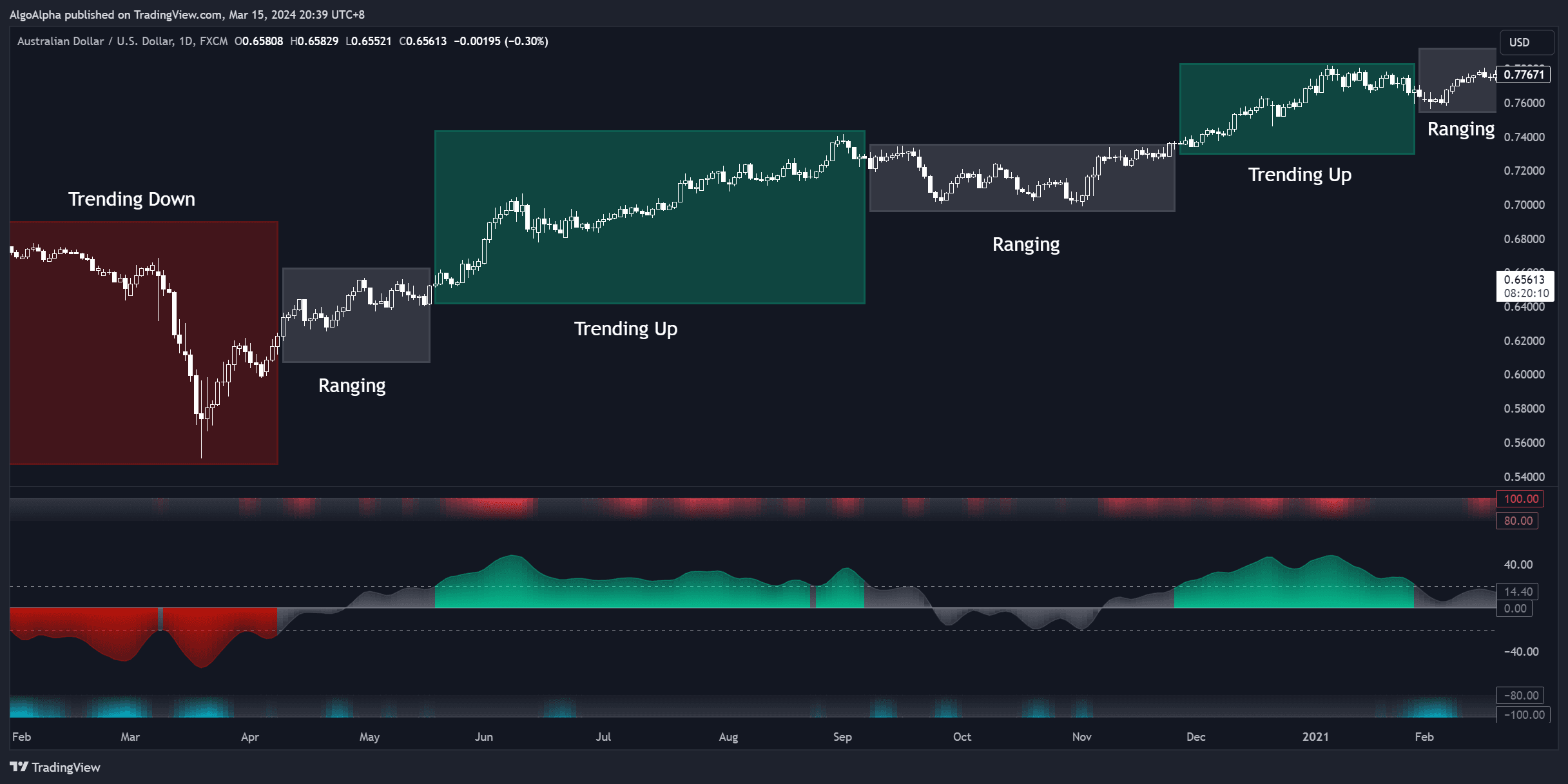
Reading the Histogram
| Visual Element | Meaning |
|---|---|
| Positive bars (above zero) | Bullish impulse — a sustained upward momentum force is active |
| Negative bars (below zero) | Bearish impulse — a sustained downward momentum force is active |
| Bars growing in height | Impulse is strengthening — the trend is accelerating |
| Bars shrinking in height | Impulse is weakening — the trend may be losing steam |
| Bars near zero | Consolidation — no clear directional impulse, typically a range-bound market |
| Color intensity | Brighter colors indicate stronger impulse; faded colors indicate weakening |
Regime Detection
One of the most valuable uses of the Momentum Impulse is classifying the current market regime:
| Regime | Impulse Behavior | Trading Implication |
|---|---|---|
| Strong Trend | Large, growing bars consistently on one side of zero | Trade with the trend; avoid counter-trend entries |
| Weakening Trend | Bars on one side but shrinking in height | Consider tightening stops or taking partial profits |
| Consolidation | Small bars oscillating around zero | Avoid trend-following strategies; consider range trading or sitting out |
| Regime Shift | Bars cross from one side of zero to the other | Potential new trend beginning — watch for confirmation |
Divergence Detection
The Momentum Impulse participates in the automatic divergence detection system:
- Regular divergence: Price makes a new high/low but the Impulse histogram does not — suggests the trend is losing underlying momentum
- Hidden divergence: The Impulse makes a new extreme but price does not follow — suggests the current trend is likely to continue
Divergences on the Momentum Impulse tend to be more significant than those on the Fast Oscillator because they represent longer-duration momentum shifts.
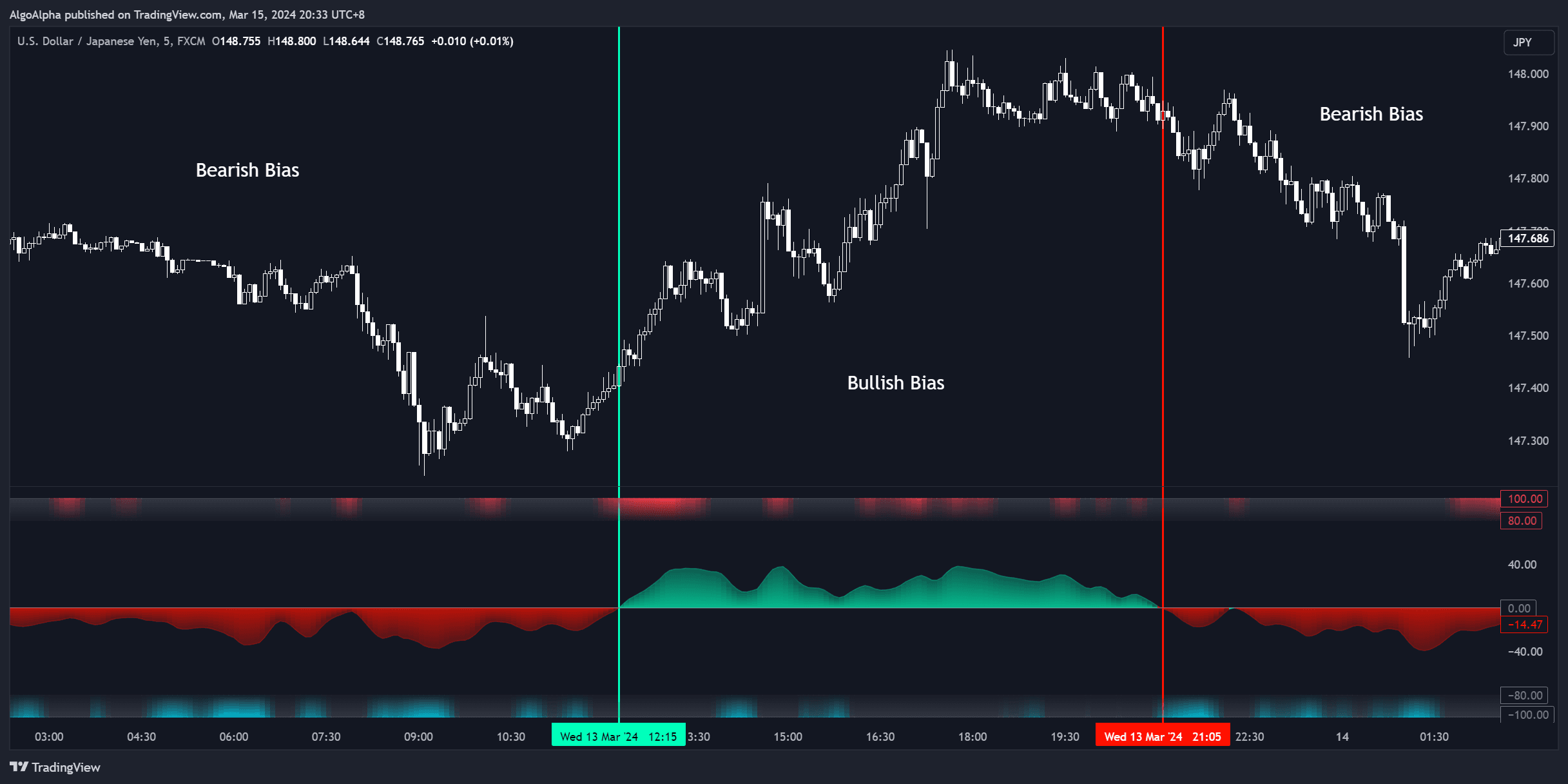
Trading with the Momentum Impulse
Trend Filter
Use the Impulse as a directional filter for other signals:
- When Impulse bars are positive and growing, only take long entries from other indicators
- When Impulse bars are negative and growing, only take short entries
- When Impulse is flat near zero, avoid new positions or trade only range-bound strategies
Swing Trade Entries
For multi-day swing trades, the Momentum Impulse provides reliable entry timing:
- Wait for the Impulse to cross from negative to positive (for longs) or positive to negative (for shorts)
- Confirm the cross with a BOS event on ILPAC or a trend signal from Smart Signals Assistant
- Enter in the direction of the new impulse
- Hold the position until the Impulse bars begin shrinking or cross back through zero
Combining with Other Oscillators
The Momentum Impulse works well paired with the Fast Oscillator:
- Impulse bullish + Fast Oscillator oversold: Strong buy signal — the macro trend is up and short-term momentum has pulled back to an entry zone
- Impulse bearish + Fast Oscillator overbought: Strong sell signal — the macro trend is down and short-term momentum has bounced into a resistance zone
The Momentum Impulse is best suited for timeframes from 15 minutes to daily. On very low timeframes (1-5 minute), the Fast Oscillator or Scalper's Momentum will be more responsive.